5 min
ABA vs. Sensory Integration Therapy: Finding the Right Path for Your Child
Navigating the complexities of developmental support can be overwhelming. This guide breaks down the core differences between Applied Behavior Analysis (ABA) and Sensory Integration Therapy (SIT), helping parents identify whether their child’s challenges are behavioral or sensory-based.
Category
Child Development & Therapy
Category
Child Development & Therapy
Date
May 7, 2026
Date
May 7, 2026
Finding the right support for your child can feel like navigating a maze without a map. You’re likely exhausted, perhaps a bit heartbroken after the latest meltdown, and simply want to see your child feel comfortable in their own skin.
When you see your child struggling, the first big question is usually: "Is this a behavior they’ve learned, or is their body overwhelmed by the world around them?" Understanding the difference between Applied Behavior Analysis (ABA) and Sensory Integration Therapy (SIT) is the first step toward bringing peace back to your home.
Two Paths, One Goal: Supporting Your Child
ABA: The Coach for Life Skills
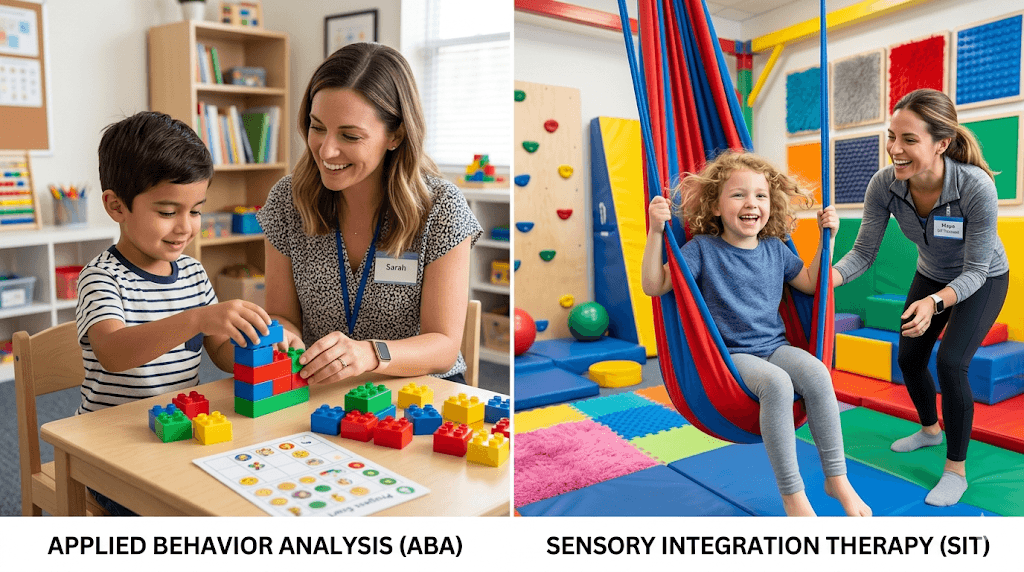
Think of Applied Behavior Analysis (ABA) as a gentle, structured coach. If your child struggles with the "how" of daily life—like asking for a snack instead of screaming, or learning how to wait for a turn—ABA provides the roadmap.
It’s built on the idea that all behavior happens for a reason (to get something, to avoid something, or to gain attention). A therapist breaks down big, scary challenges into tiny, "I-can-do-this" steps. When your child succeeds, they get immediate, positive reinforcement.
Best for: Learning life skills, improving communication, and replacing "big" behaviors (like hitting) with safer ways to express needs.
SIT: The "Brain Gym" for Comfort and Learning
While ABA focuses on what your child does, Sensory Integration Therapy (SIT) focuses on how your child feels. For some kids, the world is physically painful. A flickering light might feel like a strobe, and a soft t-shirt tag might feel like a serrated knife.
Run by Occupational Therapists, SIT looks like play—swinging, jumping into foam pits, or deep-pressure hugs. It "rewires" the brain to process touch, sound, and movement more smoothly.
Best for: Kids who seem "clumsy," cover their ears at common sounds, or are "sensory seekers" who can't sit still.
Beyond "Sensory": SIT for Learning and School Success
It’s a common misconception that SIT is only for children with autism. In reality, SIT is a foundational tool for children struggling with Learning Disorders (LD), ADHD, and Dysgraphia.
When a child’s sensory system is out of sync, their brain is working overtime just to keep their body upright and organized. This leaves very little "fuel" left for higher-level tasks like reading or math. SIT helps bridge this gap:
Focus (ADHD): SIT provides "heavy work" (like pushing weighted objects) that satisfies a child's craving for movement, allowing them to finally settle down and listen to a teacher.
Reading: SIT uses activities like swinging while catching a ball to help the eyes track smoothly across a page.
Handwriting (Dysgraphia): By improving "body awareness," SIT helps kids hold a pencil correctly without having to think about it, freeing their minds to focus on the story they are writing.
The Parent Detective: Is it Sensory or Behavior?
Distinguishing between the two is one of the hardest jobs a parent has. Look for these clues during the next meltdown:
It might be Sensory if:
The Trigger is Environmental: It happens every time the vacuum runs, the mall gets crowded, or the room lights are too bright.
The Reaction is Fear-Based: Your child looks panicked, covers their eyes or ears, tries to hide, or seems physically pained.
The "Fix" is Quiet: Moving to a dark, silent room or providing a "sensory break" stops the meltdown almost instantly without you having to give in to a demand.
It might be Behavior if:
The Trigger is a Boundary: It happens specifically when you say "No," ask them to put away the iPad, or transition to a non-preferred task like bedtime.
The Reaction is Social: Your child looks at you to see your reaction, continues the behavior until they get a specific result, or "negotiates" through the tantrum.
The "Fix" is a Reward: Giving them the cookie, the toy, or the extra five minutes of screen time stops the meltdown immediately.
Why You Don't Always Have to Choose
These two paths often meet. Imagine your child is in a constant state of sensory "red alert." They can't learn to share a toy (ABA) if their brain is screaming because the room is too loud (SIT).
Many families find that SIT helps "lower the volume" of the world, making it possible for the child to then focus and learn through ABA. Think of SIT as strengthening the foundation of a house, and ABA as building the rooms where your child lives and plays.
Your Next Steps
Observe without judgment: Keep a notebook for three days. Note what happened right before a meltdown—was it a sound or a request?
Consult the pros: Talk to your specialists about a "Sensory Profile" and a functional behavior assessment.
Trust your gut: You know your child better than any manual. If a therapy doesn't feel right, it’s okay to pivot.
You’re doing an incredible job navigating this. Simply by looking for these answers, you’re providing the advocacy your child needs to thrive.
Finding the right support for your child can feel like navigating a maze without a map. You’re likely exhausted, perhaps a bit heartbroken after the latest meltdown, and simply want to see your child feel comfortable in their own skin.
When you see your child struggling, the first big question is usually: "Is this a behavior they’ve learned, or is their body overwhelmed by the world around them?" Understanding the difference between Applied Behavior Analysis (ABA) and Sensory Integration Therapy (SIT) is the first step toward bringing peace back to your home.
Two Paths, One Goal: Supporting Your Child
ABA: The Coach for Life Skills
Think of Applied Behavior Analysis (ABA) as a gentle, structured coach. If your child struggles with the "how" of daily life—like asking for a snack instead of screaming, or learning how to wait for a turn—ABA provides the roadmap.
It’s built on the idea that all behavior happens for a reason (to get something, to avoid something, or to gain attention). A therapist breaks down big, scary challenges into tiny, "I-can-do-this" steps. When your child succeeds, they get immediate, positive reinforcement.
Best for: Learning life skills, improving communication, and replacing "big" behaviors (like hitting) with safer ways to express needs.
SIT: The "Brain Gym" for Comfort and Learning
While ABA focuses on what your child does, Sensory Integration Therapy (SIT) focuses on how your child feels. For some kids, the world is physically painful. A flickering light might feel like a strobe, and a soft t-shirt tag might feel like a serrated knife.
Run by Occupational Therapists, SIT looks like play—swinging, jumping into foam pits, or deep-pressure hugs. It "rewires" the brain to process touch, sound, and movement more smoothly.
Best for: Kids who seem "clumsy," cover their ears at common sounds, or are "sensory seekers" who can't sit still.
Beyond "Sensory": SIT for Learning and School Success
It’s a common misconception that SIT is only for children with autism. In reality, SIT is a foundational tool for children struggling with Learning Disorders (LD), ADHD, and Dysgraphia.
When a child’s sensory system is out of sync, their brain is working overtime just to keep their body upright and organized. This leaves very little "fuel" left for higher-level tasks like reading or math. SIT helps bridge this gap:
Focus (ADHD): SIT provides "heavy work" (like pushing weighted objects) that satisfies a child's craving for movement, allowing them to finally settle down and listen to a teacher.
Reading: SIT uses activities like swinging while catching a ball to help the eyes track smoothly across a page.
Handwriting (Dysgraphia): By improving "body awareness," SIT helps kids hold a pencil correctly without having to think about it, freeing their minds to focus on the story they are writing.
The Parent Detective: Is it Sensory or Behavior?
Distinguishing between the two is one of the hardest jobs a parent has. Look for these clues during the next meltdown:
It might be Sensory if:
The Trigger is Environmental: It happens every time the vacuum runs, the mall gets crowded, or the room lights are too bright.
The Reaction is Fear-Based: Your child looks panicked, covers their eyes or ears, tries to hide, or seems physically pained.
The "Fix" is Quiet: Moving to a dark, silent room or providing a "sensory break" stops the meltdown almost instantly without you having to give in to a demand.
It might be Behavior if:
The Trigger is a Boundary: It happens specifically when you say "No," ask them to put away the iPad, or transition to a non-preferred task like bedtime.
The Reaction is Social: Your child looks at you to see your reaction, continues the behavior until they get a specific result, or "negotiates" through the tantrum.
The "Fix" is a Reward: Giving them the cookie, the toy, or the extra five minutes of screen time stops the meltdown immediately.
Why You Don't Always Have to Choose
These two paths often meet. Imagine your child is in a constant state of sensory "red alert." They can't learn to share a toy (ABA) if their brain is screaming because the room is too loud (SIT).
Many families find that SIT helps "lower the volume" of the world, making it possible for the child to then focus and learn through ABA. Think of SIT as strengthening the foundation of a house, and ABA as building the rooms where your child lives and plays.
Your Next Steps
Observe without judgment: Keep a notebook for three days. Note what happened right before a meltdown—was it a sound or a request?
Consult the pros: Talk to your specialists about a "Sensory Profile" and a functional behavior assessment.
Trust your gut: You know your child better than any manual. If a therapy doesn't feel right, it’s okay to pivot.
You’re doing an incredible job navigating this. Simply by looking for these answers, you’re providing the advocacy your child needs to thrive.


Related Blogs
Explore more related projects that delivered real impact and lasting growth.