5 min
When Should You Start Speech Therapy? Early Signs Parents Should Not Ignore
A proactive guide for parents to identify key communication milestones and understand when "waiting and seeing" should turn into professional support for a child's speech development.
Category
Developmental Milestones
Category
Developmental Milestones
Date
May 7, 2026
Date
May 7, 2026

Many parents wonder, “Is my child just developing in their own time, or is this something I should be concerned about?” That question is incredibly common, and the truth is that speech and language skills develop at different speeds for every child. Still, there are some early signs that should not be ignored, especially because getting help early can make a meaningful difference in your child’s communication, confidence, and social development.
Speech therapy does not always mean a child has a serious problem. In many cases, it simply means they need extra support to build the skills that help them express themselves, understand others, and feel more comfortable in everyday interactions. The earlier a difficulty is identified, the easier it is to support your child in a way that feels natural, encouraging, and effective.
Early signs that may mean your child needs speech therapy
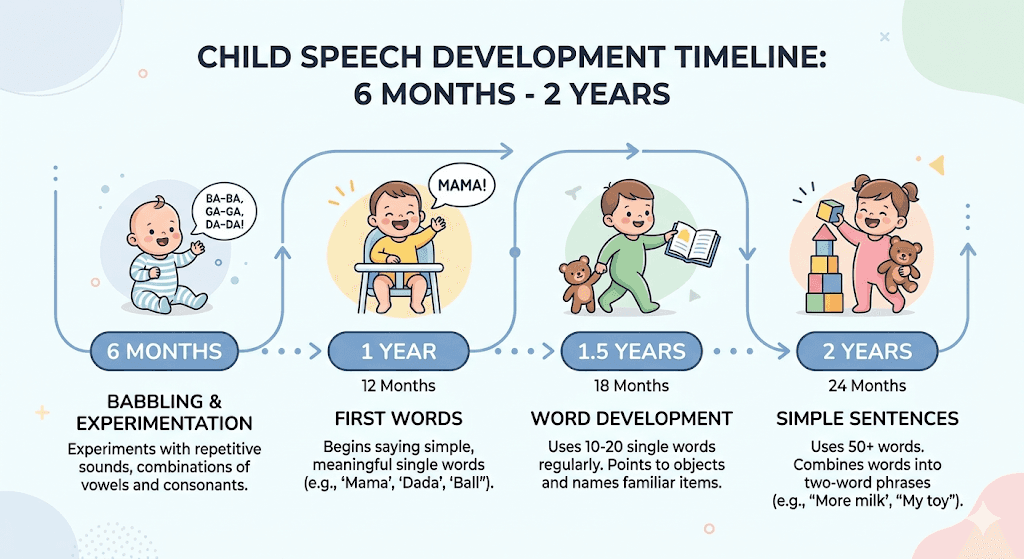
One of the earliest things to watch for is whether your child is making sounds and babbling as expected. By around 6 months, babies usually begin experimenting with sounds like “ba-ba” or “da-da.” If babbling is limited or not happening at all, it may be worth bringing up with a professional.
By 12 to 15 months, many children are using a few simple words such as “mama,” “dada,” or names for familiar objects. If your child is not using first words by this stage, that can be an early sign of a speech or language delay.
By 18 months, many children have a growing vocabulary and may know at least 50 words. They may also try to point, gesture, or use sounds to communicate what they want. If your child has very few words at this age, or seems to rely mostly on crying, pointing, or pulling you to what they need, it may be time to seek guidance.
By age 2, children are often starting to put two words together, such as “more juice,” “mummy come,” or “big car.” If your child is not combining words yet, or seems frustrated when trying to communicate, speech therapy may help them build these early language skills.
Other warning signs parents should notice
Sometimes speech concerns are not only about how many words a child says. A child may also need support if they do not respond to their name by around 12 months, seem to ignore familiar voices, or have trouble following simple directions. These can be signs that receptive language, which is the ability to understand language, may also need attention.
Another sign is speech that is difficult for family members to understand. While young children naturally make mistakes as they learn to talk, a child who is much harder to understand than expected for their age may benefit from a speech-language assessment. You may also notice that your child gets very frustrated when trying to communicate, avoids talking, or seems to use fewer words than other children their age.
Why early intervention matters
Early intervention is powerful because it supports children during the years when their brains are developing rapidly. When speech therapy begins early, children often make progress faster because they are learning communication skills before frustration, social withdrawal, or learning gaps become bigger challenges.
Speech therapy can help a child find better ways to express needs, join in play, answer questions, and connect with family members and peers. It also gives parents practical strategies to use at home, which makes progress more consistent and reassuring.
What parents can do next
If you are noticing one or more of these signs, trust your instinct. You do not need to wait and see for too long if something feels off. A speech-language assessment can help you understand whether your child is simply following a slower path or whether they would benefit from extra support.
If speech or language feels delayed, early support can open the door to stronger communication, better confidence, and brighter everyday interactions.
Many parents wonder, “Is my child just developing in their own time, or is this something I should be concerned about?” That question is incredibly common, and the truth is that speech and language skills develop at different speeds for every child. Still, there are some early signs that should not be ignored, especially because getting help early can make a meaningful difference in your child’s communication, confidence, and social development.
Speech therapy does not always mean a child has a serious problem. In many cases, it simply means they need extra support to build the skills that help them express themselves, understand others, and feel more comfortable in everyday interactions. The earlier a difficulty is identified, the easier it is to support your child in a way that feels natural, encouraging, and effective.
Early signs that may mean your child needs speech therapy
One of the earliest things to watch for is whether your child is making sounds and babbling as expected. By around 6 months, babies usually begin experimenting with sounds like “ba-ba” or “da-da.” If babbling is limited or not happening at all, it may be worth bringing up with a professional.
By 12 to 15 months, many children are using a few simple words such as “mama,” “dada,” or names for familiar objects. If your child is not using first words by this stage, that can be an early sign of a speech or language delay.
By 18 months, many children have a growing vocabulary and may know at least 50 words. They may also try to point, gesture, or use sounds to communicate what they want. If your child has very few words at this age, or seems to rely mostly on crying, pointing, or pulling you to what they need, it may be time to seek guidance.
By age 2, children are often starting to put two words together, such as “more juice,” “mummy come,” or “big car.” If your child is not combining words yet, or seems frustrated when trying to communicate, speech therapy may help them build these early language skills.
Other warning signs parents should notice
Sometimes speech concerns are not only about how many words a child says. A child may also need support if they do not respond to their name by around 12 months, seem to ignore familiar voices, or have trouble following simple directions. These can be signs that receptive language, which is the ability to understand language, may also need attention.
Another sign is speech that is difficult for family members to understand. While young children naturally make mistakes as they learn to talk, a child who is much harder to understand than expected for their age may benefit from a speech-language assessment. You may also notice that your child gets very frustrated when trying to communicate, avoids talking, or seems to use fewer words than other children their age.
Why early intervention matters
Early intervention is powerful because it supports children during the years when their brains are developing rapidly. When speech therapy begins early, children often make progress faster because they are learning communication skills before frustration, social withdrawal, or learning gaps become bigger challenges.
Speech therapy can help a child find better ways to express needs, join in play, answer questions, and connect with family members and peers. It also gives parents practical strategies to use at home, which makes progress more consistent and reassuring.
What parents can do next
If you are noticing one or more of these signs, trust your instinct. You do not need to wait and see for too long if something feels off. A speech-language assessment can help you understand whether your child is simply following a slower path or whether they would benefit from extra support.
If speech or language feels delayed, early support can open the door to stronger communication, better confidence, and brighter everyday interactions.
Related Blogs
Explore more related projects that delivered real impact and lasting growth.